Sunday, July 3, 2011

Karma's Luck

Fun Fact: Did you know that a symbol on the Singapore dollar glows neon while under a blacklight?

I found out this interesting fact while taking out some money while at a "Glow In the Dark" store, that's something I didn't expect. Singapore has an interesting relationship with money, whether it be through anti-forging measures (their money is not paper, but plastic) or even traditions on good karma and wealth. I found this tidbit out when one of my coworkers from Spain found a S$5 bill on the ground while heading in for work, thus leading to a deep conversation on the ethics of money. My Singaporean grad student supervisor all asked us this simple question after hearing about his discovery, "If you found money on the ground, what would you do with it?" I had to answer with, "It depends on the amount of money," because a small amount of money found and kept isn't hurting anybody, right? Now imagine yourself stumbling on $5 or maybe even $20 0r $100, how would this scenario play out with you? Personally, a small amount is no big deal. Now if it was a large amount, I would report it missing. BUT interestingly enough, even if it's a coin found on the ground, the most reasonable thing that my grad student would do...is donate it. Every effort would be made to find the owner of the missing money because it is actually bad luck for you, the finder, to keep the financial gain. Why? Because you are actually passing bad luck to yourself! In essence, you used up your good luck in place of someone elses bad luck--and bad karma will kick in as a result. I might take that moral to heart and donate dropped money in the future because it is with good reason.

My 21st birthday update! WOW I have never had so much fun on my birthday weekend in my life. My birthday (June 17) landed on a friday, so I worked for most of the day with a really cool morning birthday surprise crafted by Devinn, then I visited Asia Beerfest, which was epic. I have never seen so many beers in one place in my life, but I only sampled a Kronenberg lager and decided that was enough to last me the whole night. I then met my co-workers at Zam Zam Singapore Indian restaurant, but I was too late to eat anything! So we went for desserts on Arab Street, a beautiful Arabian District with mosques on almost every corner, and street venders selling really good (and spicy) food and elegant sari's and pashmina scarves. It was soo pretty so I will be making another visit on a different date, but for dessert, I had to try out a homemade wine sherbert. We followed up with yet another excursion for really interesting Singaporean desserts--I bought beancurd and You Tiao, which is a delish pastry (pics below). That sums up Friday night fun!

Saturday, one of my co-workers invited me to a picnic on Sentosa beach, a really popular beach in Southern Singapore. We followed it up with good food, great desserts (Ias Kacang!), and wonderful company. The topper of the night was seaside fireworks! I can honestly say that this was the best birthday I have ever had, and these memories stick with me forever.


It's really pleasant to have a good relationship with my co-workers as most of them are around my age (ranging from19 to 24 yrs old). But when we are all in the lab, we know there is work to be done! I can't give too much information on my exact experiments (company policy, and if that is strict for ya, you should see the armed soldier with a barking german shepard that I have to pass at the gates to get to work, plus the metal detector scanning with biometric card and fingerprinting). What I can say is that I am running experiments on increasing glycerol production in algae by modifying its environment. Currently, I am testing the total carbon that composes the algae to determine the percent carbon dedication to glycerol synthesis. It's really fun stuff and I cannot wait to see the results!

As a side note, I have had really interesting luck with meeting and making friends with Singaporean people. The weekend after my birthday, I decided to go to Chinese Gardens at 10pm (mind you, the gardens close at 11 pm, I don't know what possesed me to go up there so late anyway) and I was walking around Fragrance Garden enjoying the floral air until I seen bright lights on a fancy Chinese pagoda. So I was curious and walked over to the lights and guess what I saw... a film crew! A large group of people were actually filming a scene from a movie "True Love" that they expect to enter into Indie movie festivals. The movie is about a husband and wife who have to make a decision on who they really love in life due to a series of unfortunate events. The husband made a bad decision with a gangster loan shark and must now decide on taking the life of his wife or another man affiliated with the loan, but things get heated when he finds that his wife is in love with someone else...another woman.

It was the coolest thing EVER, but I forgot my camera!! I got to see two scenes being filmed, one being the choking and death scene but I can't tell you who the husband chose! And another where the woman ended the relationship with the wife. I also met the actor and actresses that were in the scenes along with the makeup artist, movie photographer, and the movie director! The movie should be finished soon si I will be sure to post updates. Shocklingly, everyone was around my age, with the director being at the ripe age of 24, so we swapped facebook accounts (oh, facebook) and one of the actresses gave me her phone number, that was unreal! Most of the crew was Singaporean with the remaining few from San Francisco, CA. I actually HAD to get to know the film crew after a while because the garden ranger came over to us and was yelling at us for being at the gardens for so long (this was 10:55pm, technically my cue to leave but I couldn't resist!). A little over a half hour later (11:30pm, past garden closing time) the guard returns and starts shouting swear words at the director in both English and Malay language! Everyone told me that the guard would only do the same to me if I left now so I had to stay with them until the end, which ended up being 12:00am. They actually had one more scene to shoot but I had had enough action for one night. Then, a few weeks later, the actress called me and invited me to a Ladies Night Out, which I was more than happy to attend (pics below with the director crashing in on our ladies night!). It was soo much fun, I can't contain it! If only words could describe! I can't even catch a film crew in the US! I still have more adventures to share, including our 4th of July, Singapore-style! That is all for now and good luck on your adventures!


~Lynnicia

Saturday, July 2, 2011

Diving into the unknown

Okay, so remember when I told you I was the lone snorkeler? I'm a turncoat, I did a resort diving course and BOOM! I can dive! Wow, you have no idea what a completely different world it is down there. Looking up and just seeing a massive wall of coral that stands above you by about 40 feet, or being on the same level as a school of lutjanidae (snappers)! It's really spectacular to come into a marine program with absolutely no background in marine science and to just see it and fall in love with a subject so completely and so quickly!

Alas, my time in Little Cayman isn't going to last forever. The whole group flies out on Wednesday and we all still have to finish our authentic symposium style science posters of our projects! Yikes! I still have a whole analysis to come up with! Actually, I haven't really said much about my project have I? Briefly, I'm measuring the spalling and growth rates of green algae, specifically halimeda sp., because it is a major producer of sand and helps prevent erosion on island beaches. What I am really trying to answer with my project is how much sand is the result of calcified halimeda? How quickly does it generate, spall and form, and also what amount is being calcified and not eaten. That's a lot to answer in only a few weeks of research....

Tonight our little research group, or the "students" as we are collectively referred to by the "scientists" that are also staying here, went out to eat! It was a productive night, during which many of our party were reunited with the love of their lives, which is PIZZA! So if anyone is on Little Cayman on a Saturday night, go to the Hungry Iguana and eat some pizza!

One last thing before I go camp out in my bed till tomorrow, I can't believe how many new friends I have made during this trip. Everyone is just right, and we all know how to have a good time, enjoy the ocean and get work done. That's it! I just thought that they deserved a little shout out on this blog. :)

G'Night!

Friday, July 1, 2011

TT and Tea

I slipped into my co-workers’ conversation midway during lunch. They are a hilarious group of people-I believe most of them are from India or from Indian descent. When they get really involved in discussion their voices get much louder and their accents come through a bit more. Sometimes they will jump to Tamil for a few seconds and then come back to English-their banter is very dynamic it reminds me of hanging out with my friends back home.
Then I was invited to play TT (Table Tennis) by one of my co-workers. I was a little intimidated at first because I heard he was the best in the lab, and his title is rightfully claimed. He gave me a run for my money and then some, beat me 15-7 and 15-3 but both times I think the points I one were more so for his mistakes rather than me winning the point. I think my brother Colton could have given him a fair match, but alas I am not my brother-one time when my co-worker slammed/spiked the ball at me I put my arms up to defend myself-my mentor saw this and laughed. So, I’ll try to play a bit every day at work and maybe at the end of the summer I’ll get a few more points or at least not flinch when a fast ball comes my way.
Afterwards I went to get tea with the group. I had ginger tea, it is very aromatic and sweat (made with milk). My mentor also told me that it should help me digest my lunch (most of the spices here have a purpose besides flavor). However, tea time was not as relaxing as I expected because the repartee switched to have America and therefore me as the center of attention.
FYI trying to be the authority figure on everything that is American and America is exhausting-I should have done more research on America before I came here. What I have learned is that any bit of news that catches American national headlines has probably also hit global headlines as well (or at least Singapore’s news). When my mentor handed me my tea, he told me to be careful because I can’t sue if I spill some on myself (reference to the law case where someone at McDonalds sued for the hot coffee that burned them). Then conversation bounced to why 60% of Americans are obese. All I could say is that I am not obese and that I don’t know many obese people, but that doesn’t do much to fight that statistic.
Conversation then deviated from America for a moment to Chinese versus Malay and Indian food in Singapore. One person said how Malay and Indian food is regarded by more people as unhealthy, when in actuality Chinese people have higher cholesterol levels and heart disease than any group in Singapore. There was some acrimony in his tone and it struck me to consider if there is a bias from an unofficial racial hierarchy in Singapore. In my head, I briefly related this to a play I saw last weekend.
The play was called “Pariah”. The setting was in Malaysia and the entire dialogue spoken in Malay with English subtitles for us to read. While the plot was fictional, it related to true events. A group of four college friends, two Malay, one Indian, and one Chinese had to read a book in class which presented Indians and Chinese people in a negative light whereas uplifted the Malaysian people. The book, which was a required reading by order of the Malaysian Ministry of Education (I believe), stirred a group of Indian students to take action and fractionated the group of friends. Eventually their bonds of friendship are restored, but this was after we journeyed through each person’s life and uncovered complex and unsettling emotions of cultural displacement, isolation, sexism, and racism. The story was familiar, it was as if you could use the same plot line but substitute the characters for people of European and African descent. If that happened it would be like the story of the Civil Rights Movement in America. If you substituted in other ethnicities and populations, it would represent the daily dynamics and churning that occurs in the American melting pot this day and age as it continues to strive for equality for all. Maybe our own problems are others as well…
What was awakening for me was that the word pariah was very taboo in the story. I learned the word pariah in ninth grade as a description for the lowest class in the caste system that previously existed (and maybe remnants of it still do remain) in India. However, the sensitivity of the word as presented in this play was equivalent to using the N word in the United States. It is amazing to me that the stigma of the word pariah lost its significance as it traveled over seas and into my textbooks. It makes me wonder if all deeply rooted traditions, words, and ideas, both glorious and horrific, dull as they travel from their origin.
Of course, the past two paragraphs are a bit of a tangent, I didn’t have all this time to consider these thoughts during my tea time conversation because after this moment we bounced back to America.
Gun control policy.
I was asked, “why are Americans allowed to own guns?”
My response, “so they can protect themselves and it is not like anyone can own one, they have to be registered.”
“But it can’t be that difficult to get one. Plus why is there the need for this gun culture. It is the job of the police department to protect the people, if people have guns why have a police department.”
Gun culture? When did America get a gun culture? I thought. But I know that in Texas you can carry a gun in public (it is almost like a pride thing), that in some city areas people conceal guns (for threat and power), and others hide them in their homes and stores (for protection). Does America have a gun culture? My thought for response is that you can’t generalize America like that, but wouldn’t that mean we have different gun cultures across the US? Maybe we do, but from where I am from no we don’t. I think that is the most difficult part of playing the role as expert American-the story of my life only holds true to a small group of people. I feel like for most of the questions I am asked my response is that it is not that simple and that you cannot generalize.
The fair response I’ve learned for these pressing questions is to make a distressed, but comical sigh and for the most part listen to what everyone has to say. It is amazing how well informed the Singaporeans (which I have spoken with, to avoid generalization) are about American issues. One person was citing a documentary he saw about Columbine and Food Inc. When we got back to Immunos I mentioned how the conversation was mind opening and then we returned to the banter the conversation started at. One person said to me come to lunch more often; 30 minutes of TT a day and 30 minutes of mind opening.

Sounds like a plan to me.
=]

Thursday, June 30, 2011

The Steps to Little Cayman

My trip is winding down, so I thought I would take this time to think about all the things that have happened on this trip and what’s important.

One. Always put on sunscreen, and reapply, even if you’ve already done it 4 times.

I was out for my research project for the 5th time one day and was constantly faced down snorkeling in the water. I finally get out and one of my professor’s daughters sees me and asks, “Do you need aloe? That looks like it hurts.” I went upstairs and looked in the mirror. My back was incredibly red, AND even worse I decided to wear a one piece that day. I’m still trying to get rid of the terrible tan lines.

Two. Always put on bug spray. Get over the nasty sticky feeling, the gross smell, the stinging on previous bug bites.

And always apply on your ankles...Even though some nights aren’t bad, they still find a way. Some mosquitoes are large and obvious, others small and annoying. I currently have open wounds all over my legs….

Three: Your hair never looks good and your feet always have sand on them.
You’re on a beach, get over it?

Four: Think about your project. I’ve been working on my project, alone, and to complete it in only about the week time we have left of the course, it’s somewhat overwhelming.

Five: You’re going to have to open up some fish, get used to the smell. Lionfish to be exact. The invasive species. Here on Little Cayman, CCMI goes on a spear fishing day every week to spear them. As one of our classes we got to dissect them, take out their stomachs, and see what they ate. It was pretty entertaining.

Six: Don’t ask about the sea urchins.

One of my project sites is in a huge patch where sea urchins love to chill. They are bio eroders, which means they erode the sediment around them and stay there during the day and come out during the night to feed. I have to walk over all of these caverns and I’m terrified of stepping on one (even in think soled booties).

So I asked my professor, “What do I do if I step on a sea urchin?” His response was “You don’t”…helpful right?...it gets better
I asked one of the other students, Ally (also a blogger) and she replied “I think you have to sit and wait until the spines dissolve”.
I ask my one professors daughter and she says “you get sent to the nurse”. (there is no dr. on Little Cayman).

I still had no idea of what to do if I stepped on one, so I goggled it. :D
My professor was right, you just don’t step on one…haha

Seven: Stay in touch with reality. After a few days here, it starts to feel like a month. You get used to the heat, the sunburn, the bug bites, the lack of air condition, etc so on. But you start to go crazy. This isn’t something you can be prepared for, it just kind of happens. Nor can I explain it.

Eight: Fight your fears. During our dives I usually never end up seeing much until someone points it out to me. On our 5th or so dive I was looking out to the large ocean, while I was supposed to be doing a point fish count (oops), and see a shark. Instead of being freaked out, I got excited.

A few days later, I was out in the shallow area behind CCMI (the research center I’m staying at) alone, and started to panic that I was going to be attacked by a shark. I suggest you don’t panic, and just get over it. Fear is annoying like that.

Nine: Be ready for anything. Literally. On the town, in the water, during research. I almost lost my entire project due to the excessive waviness of the ocean (it hadn’t been wavy previous days). Quick thinking and calmness is essential.

Ten: Realize everything is a lot smaller than you. This island is so small, and although I knew it was only 150so residents, it’s smaller than I thought. The resorts don’t even look like resorts, and there are only like 2 houses per few miles. Although it’s gorgeous and different, I don’t know how long I could stay here for. The plane is also very claustrophobic. Haha.

Eleven: Don’t play with fire.

One of the grad students that had been here for a few months was going home, and there was a party thrown for her. The party was very low key although the whole island was literally invited. At about 10 or 11 someone just walks out to an opening outside and lights these batons on fire and starts to twirl them around like crazy. It was awesome and I wasn’t expecting it. He wasn’t burned, but he did drop it a few times.

Twelve: The best form of transportation is probably bike. Although we have a van for all ten students, sometimes it sounds like it’s not going to start, and there is no air conditioning. When riding in the back of a truck for a shore dive, you get wacked in the head with a big tree branch. When riding bikes you get to save hermit crabs crossing the road, stop wherever you want, drive on the right side of the road, (even though here the proper side is the left), and exercise.

Thirteen: Diving is amazing. Although the water is amazing from the top, with all the different color blues, and the water spraying your face, the dive is even better. It’s where you get to see those blues come to life. Pictures can’t even describe how small and insignificant you feel when you are already 50 ft down, but the coral reef wall just plummets beneath you. It’s a completely different world; it’s scary sometimes, but well worth it.

Fourteen: You can party hard


Fifteen: but not too hard.


I just turned 21, and although the drinking age is 18 here, it is still awesome to drink legally. But by the end of a long week and a long night sometimes you’re just exhausted. I’ve had more fun here than in NJ and the best part is the culture and what they expect and how the people here treat you. Its fun, exciting, not quite new, but different.
And at the end of the day, we can’t forget all the work we have to do.

And well….Sixteen: It is gorgeous here, and even though every day is simple (I looked at a TV the other day and was so confused), the simplicity is what makes this trip special. Well, we are always busy, always wait for the lunch and dinner bell, and get excited to go to bed, but for the most part life is simple here. Just crazy. I am learning more than I thought I would and I’ll probably take more out of this 2 and half week course than I would from a whole semester sitting in a classroom.


Piecein’ out, its time for some project powerpoint work.


Well…I do have 6 more days….maybe it can wait? You’ll never know.

Heather
ps. i had pictures...but internet in little cayman is apparently not to excited about this endevour. Apologies. I'll update it another time!

France 2011 Day 10

France 2011 Day 10

F***

This week I attended the 1st South East Asian Course on “F-techniques: FCS, FCCS, FLCS, FRET, FLIM, and FRAP.” The course was dedicated to a variety of fluorescent microscopy techniques and their applications in the life sciences. The organizers for the workshop were the Institute of Medical Biology Microscopy Unit, EINST Technology Pte Ltd. (both from Singapore) and PicoQuant GmbH (Germany).

The first day of the course was dedicated to an in depth introduction to the techniques. I began the course with a ground level understanding of fluorescent microscopy so I felt completely exhausted after the first day of introduction! Then again, the fact that I was listening to presentations from 9:00 to 6:00 may have also had something to do with that (the course provided ample amounts of coffee). Many of the following days were applications of these techniques in scientific research (all days were equally as exhausting).

To give myself some credit, I believe that the first day was more so mentally taxing because it served as a double introduction for me. The obvious introduction was the description of the different techniques: Fluorescent Correlation Spectroscopy (FCS), Fluorescent Cross Correlation Spectroscopy (FCCS), Forster Resonance Energy Transfer (FRET), Fluorescent Lifetime Imaging (FLIM), and Fluorescent Recovery After Photobleaching (FRAP). The second introduction, which now I recognize as equally apparent is the biophysics behind all of these imaging techniques.

Accompanying every picture or description of technique there was some type of formula. Sometimes they were simple ratios that promoted a correlation in data, other times they were multivariable functions sporting integrals with sprinkles of sine, cosine, and tangent-clearly the demonic offspring of geometry and calculus. Really though-once I became familiar with what the different variables meant, they were not as intimidating.

Before this course my experience with microscopy has been that you use the images you obtain to verify the presence of a structure or event; you use microscopes to provide qualitative data. While this is still true (and an excellent use of microscopy), I have also learned that these techniques and many others that I have yet to encounter can be utilized to quantify processes in biological systems.

In this regard, these fluorescent techniques help to address a personal issue of mine with biology-generally speaking the underrepresentation of quantitative data as compared to the other hard sciences. Chemisty, physicist, engineers, and obviously mathematicians all take extensive courses in math, whereas biologists typically do not. Why?

At first, I thought the answer was simply that the other areas of science we more complicated and therefore inherently relied on mathematics for explanation. Conversely, biology is a simpler subject and could be evaluated effectively through qualitative observation.

However, now I prefer to think that biology is too complicated to be easily explained by mathematics. A living system has many variables whose effects all compound on one another to create the whole, therefore mathematics has shied away from the subject. Models and in vitro experiments simplify the system for experimental evaluation, but after everything I just said is biology really just the sum of its parts?

This week I learned that F-techniques can be used to quantify in vivo experiments and therefore can glean more accurate depictions of what is occurring in a living organism. For example, FRET (my personal favorite out of the bunch) and FCCS can be used to determine the dissociation constants, diffusion rates, and concentrations of proteins in biological pathways (this is an area of research interest for my PI- Dr. Sohail Ahmed).

On most days after the course, I would review my notes and create mini PowerPoints to further interact with the material. I will share them with you (once I have our microscope guru review it) so you can get a glimpse of what I have learned this week-enjoy!

I have also learned about Superresolution microscopy which can identify the location and movement of single molecules (proteins, lipids) in a system. One of the people who spoke on this topic is Dr. Boris Lukiyanchuck, whose research publication “Optical virtual imaging at 50 nm lateral resolution with a white-light nanoscope,” captured global attention. I found his personal website and am amazed by how many Nobel laureates he has worked with (he gives them thanks-honor thy mentors) and am impressed with how many places he has worked abroad (can I count him as an example for how working abroad makes you a successful person?). Here is his website if you are interested: http://www.lukiyanchuk.ru/

I am very thankful that Dr. Sohail Ahmed invited me to attend this course, even though it was meant for graduate students and Post-docs. It has opened my eyes to new research techniques and shown me how they can be applied to address the complexity of the life sciences.

Wednesday, June 29, 2011

Swadini, Game Capture June 27-29

"Everything in Africa bites, but the safari bug is worst of all.” -Brian Jackman (2004 Travel Writer of Year)

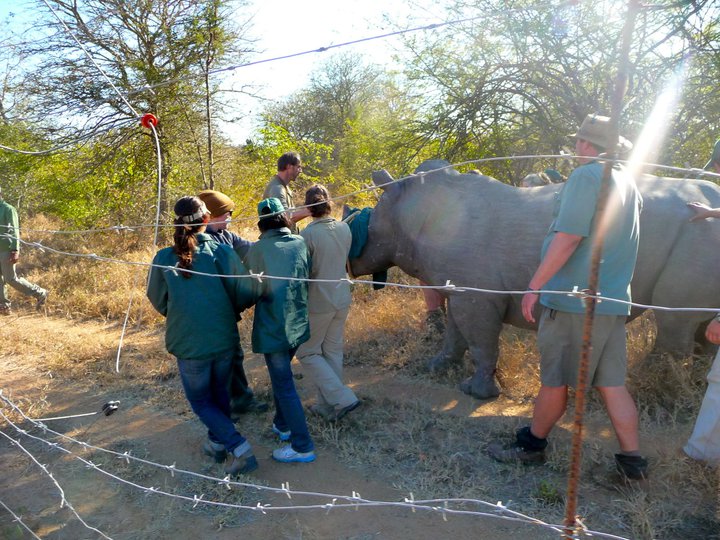
The next few days were spent with Andre Pienaar learning about game capture. We had a brief lecture on the importance of conservation and how game capture is a part of that. He mentions the drugs that he uses on the animals and the general dangers of the business. That evening we went to relocate a white rhino that had broken out of is his enclosure fighting with another male rhino. We tried to entice the rhino, Jangles, closer to the fence with alfalfa. We had little success and resorted to darting him. The drug would have 6-8 minutes before causing the rhino to fall over and making it more difficult for us to relocate him. When shot, he ran fast (rhinos can run up to 30 km/h) and Andre had to track him down. Unfortunately, the dart did not administer the drugs and the rhino was still awake and alert 20 minutes later. We would have to try again the next morning. This time they darted him from a helicopter which made it easy to keep track of where he ran to. Soon after the rhino slowed down and started to wobble. We ran out to him, blind folded him with a towel and tied a rope around this head and back leg. Our plan was to walk him across the fence line. The rope on his back leg was to be used as a brake and the one on his head extended out to his left and right to steer him. All 6,000 lbs of rhino were pulling against us as he stumbled forward. When we had him across the fence, we walked him in circles until his balance was lost and he fell over. Jangles had many wounds that needed cleaning so while half of us held him so he didn’t completely roll over, the others scrubbed him down. We ministered a bottle and a half of penicillin to prevent infection and double checked every inch of his skin. It was time for us to stand him up and let him go. It took 11 girls on one side and 4 large men on the other to rock the rhino until we managed enough momentum to stand him up. When standing the rhino almost retreated back across the fence line and it took expert steering to prevent it.Andre began to untie him, gave the antidote and told us to run in the other direction in case he turned back at us.


Once the fence was repaired we were on our way to a game ranch to remove some giraffes. A trap (called a boma) made out of tarp was already set up. It was shaped like an ice cream cone with the skinny end at the truck door and the fat end

toward the rest of the ranch. The boma was split into several sections with tarps being used as curtains and in the skinny part, actual wood was used as doors. The area between the doors had metal siding outside of the tarp. It was built high enough so the giraffes would (hopefully) not see over it because a giraffe will not go somewhere if it doesn’t see a destination. Our group of girls was split between the two doors and was given the instructions to pull the rope when commanded. The ropes, depending on what side you were on, either opened the doors or shut them. I was on the door closest to the truck, which was also next to a barbed wire fence. We were warned that an organized chaos would ensue once the giraffes reached the boma, but we were not prepared for what actually happened. A helicopter flew around the area and rounded up the giraffes until they were in the opening of the boma. It started to use sirens and whistles to warn the crew that they were coming. As the animals drew nearer the curtains furthest away were being closed and it started to get loud with voices. We heard a bunch of yelling in Afrikaans and some indistinguishable English and weren’t sure if that meant to pull or not. We turned to the other rope and saw that there were no longer only two people on it, but five or six. The yelling got louder and Andre’s workers started to climb the sides of the metal walls and tied ropes to the posts to pull them closer together. The giraffes were kicking the sides with little mercy. My partner and I weren’t sure if that was what they meant by “organized chaos” or if this was just as out of control as we thought. Unfortunately, the sides of the boma were not high enough, so the giraffes were able to see which direction freedom was. After a particularly loud kick against the metal we heard “Girls RUN!”. My partner and I dropped the rope and started to run toward the trees. Next to the barbed wire fence we found one of Andre’s boys trying to climb out, so we grabbed him and took him with us. The giraffes had torn the side of the boma and had their shoulders over the metal wall. With enough force they would be freed and running blindly into a crowd of people. Our guide told us to get on the other side of the fence which required crossing a small path of obstacles right next to the metal wall. I ran with the boy in my arms and while stepping over a log the fence caught my pants and we fell. Before I knew what was happening we were being picked up and brought out of the way. They allowed one of the doors to be opened to save the side of the boma and since they couldn’t get past the curtains. When it started to calm down and reinforcements were placed against the walls we were allowed to go back to our stations on the rope. After some more threatening kicks from the giraffes we successfully moved them into the truck. Game capture was most certainly my favorite part of the trip!